DPDP Consent Manager Rules Are Live. What Does This Mean for Hospitals? Learn more: DPDP Consent Manager Rules Are Live. What Does This Mean for Hospitals?

On 13 November 2026, only the DPDP Consent Manager registration regime went live. No hospital duty or penalty applies yet: everything starts on 13 May 2027.
What Went Live Under the DPDP Act on 13 November 2026?
Short answer: only the Consent Manager framework. On 13 November 2026, three provisions of India's Digital Personal Data Protection (DPDP) framework came into force, all of them about the registration and oversight of Consent Managers. On 14 November 2026, MeitY launched the application portal at dpbi.gov.in (MeitY press release). No new obligation on hospitals started, and no penalty can be imposed on a hospital yet.
Provision now in force | What it does |
|---|---|
Section 6(9), DPDP Act | Every Consent Manager must be registered with the Data Protection Board of India |
Section 27(1)(d), DPDP Act | The Board can inquire into a Consent Manager’s breach of its registration conditions |
Rule 4 and First Schedule, DPDP Rules 2025 | Who may register as a Consent Manager, and the duties a registered Consent Manager carries |
What is a Consent Manager under the DPDP Act?
In simple terms, a Consent Manager is a consent dashboard that works for the patient. It is one place, such as an app or website, where a person can see the consents they have given to different organisations. From there they can give, change or withdraw those consents without contacting each organisation separately.
The Act defines it as a person registered with the Data Protection Board who acts as a single point of contact for an individual to give, manage, review and withdraw consent, through an accessible, transparent and interoperable platform (Section 2(g)). It acts on the individual's behalf and answers to them, not to the hospital (Section 6(8)).
How it will work for a patient (from 13 May 2027): Say a patient agreed to receive health-camp and offer messages from your hospital. Later she opens her Consent Manager app and withdraws that consent. The withdrawal is passed on to your hospital, and you must stop sending those messages within a reasonable time.
What a Consent Manager is not:
Not your hospital's consent software. That is your own tool. A Consent Manager is an outside service the patient chooses.
Not a store of medical records. It cannot read the personal data that passes through it.
Not a substitute for your duties. Your hospital must still give proper notice, take valid consent and be able to prove it.
Who can become one: An Indian company with a net worth of at least ₹2 crore and adequate technical, operational and financial capacity, once registered with the Board. It must keep consent records for at least seven years and cannot hand its role to a subcontractor.
What it means for the healthcare industry
A new regulated category exists. Consent Managers are now a licensed class of intermediary.
Patients will get an outside consent channel. Once registered Consent Managers operate and Section 6(7) starts on 13 May 2027, a patient may give or withdraw consent to a hospital through a Consent Manager.
The regulator is not yet staffed. As of 19 November 2026, no notification had announced the appointment of the Board’s Chairperson or Members.
Nothing has changed operationally for hospitals yet. MeitY’s own release says Data Principal rights, Data Fiduciary obligations and the Board’s inquiry and penalty processes are scheduled for 13 May 2027.
DPDP Act Implementation Timeline for Hospitals
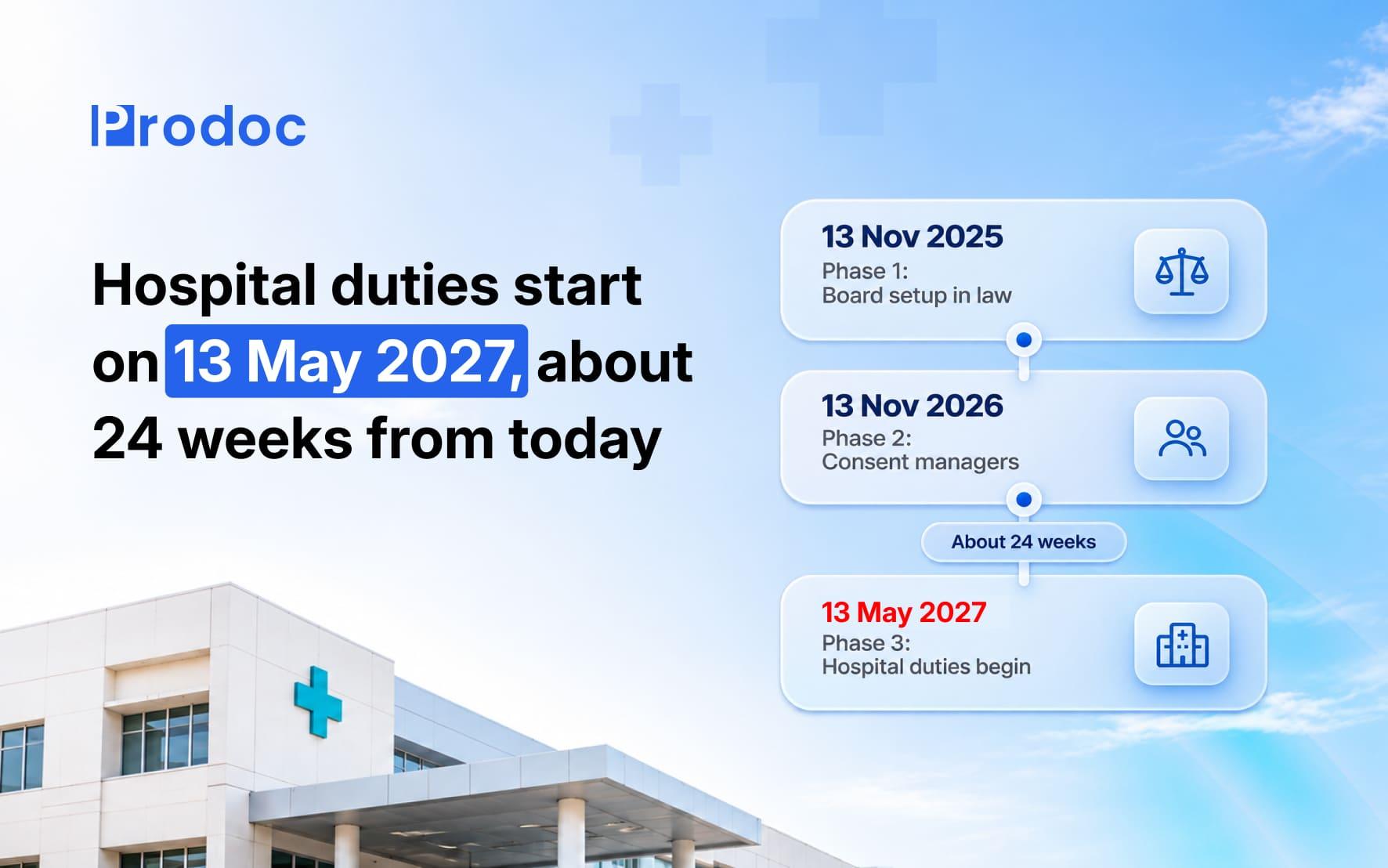
The DPDP Rules, 2025 were notified on 13 November 2025 and are being switched on in three phases under the commencement notification G.S.R. 843(E). Hospitals have about 24 weeks left (as of 27 November 2026) to prepare.
Phase | Date | What starts | Impact on hospitals |
|---|---|---|---|
Phase 1: Board set up in law | 13 Nov 2025 | Data Protection Board constituted; definitions and rule-making powers | No duties for hospitals |
Phase 2: Consent Managers | 13 Nov 2026 | Consent Manager registration (Sec 6(9), Sec 27(1)(d), Rule 4) | No duties for hospitals |
Your preparation window | 27 Nov 2026 to 13 May 2027 | About 24 weeks | Time to get operationally ready |
Phase 3: Hospital duties begin | 13 May 2027 | Notice, consent, security, breach reporting, patient rights, penalties | All duties and penalties apply |
For the full picture of what each duty means in a hospital setting, read our DPDP Act primer for healthcare or the longer guide on why healthcare leaders must act before May 2027.
What This Means for Your Hospital: DPDP Myths vs Facts
What you may have heard | The facts |
|---|---|
“DPDP is fully live, and fines of up to ₹250 crore apply now.” | No. Only the Consent Manager rules have started. Hospital duties and fines start on 13 May 2027, as MeitY confirmed on 14 November 2026. |
“The deadline was moved up to November 2026.” | No. MeitY discussed a shorter deadline in January 2026, but no official notice has changed the date, and MeitY’s 14 November 2026 release still says 13 May 2027. It may still change. |
“Hospitals must register as Consent Managers.” | No. Only companies that want to run a Consent Manager service must register. Your hospital is a “Data Fiduciary” with its own duties from May 2027. |
“Hospitals must sign up with a Consent Manager.” | Not required. From May 2027, a patient can choose to give or withdraw consent through a Consent Manager (Section 6(7)). That is the patient’s choice, but your compliance platform should be able to accept it. |
“Our consent software, or ABDM consent, already covers us.” | Not on its own. A Consent Manager is an outside, government-registered service that works for the patient; your consent software is your own tool. ABDM consent allows health records to be shared; DPDP needs consent for each purpose you use the data for. |
“Hospitals will be named Significant Data Fiduciaries this month.” | Not so far. None had been named as of 16 November 2026. Even if a hospital is named, the extra duties start only on 13 May 2027. |
“Our DPDP compliance platform vendor must also register with the government.” | No. Only Consent Managers register with the Data Protection Board. A compliance platform works for your hospital under a contract, as your Data Processor (Section 8(2)). Neither of you has anything to register, but the contract must require reasonable security safeguards. |
What Hospitals Should Do Before 13 May 2027
Our recommendation is to use the next 24 weeks to get operationally ready. Focus on five areas:
Ownership: a senior owner, a working team, and a published contact for patients’ data questions.
A patient data map: what you hold, where, why, and who you share it with, across your HIS, EMR, lab and billing systems.
Notices and consent: clear, purpose-wise and easy to withdraw, on the channels patients actually use, such as voice and WhatsApp. The hospital must be able to prove consent was taken.
Patient rights and breaches: a way for patients to see, correct or erase their data, and a breach response that can meet the 72-hour reporting window.
Vendors: HIS, cloud, billing, lab partners and other processors held accountable to the hospital for compliance, because the hospital continues to carry the compliance responsibility.
The hard part is not the list. It is the hospital-specific calls behind it: when consent is not needed, how erasure requests fit with medical-record retention, and how children’s data is handled. Settle these early, with your legal team. Our guide to DPDPA compliance software for hospitals lists the questions to ask any vendor about these cases.
Keep an eye on: Board appointments, any change to the 13 May 2027 date, and any Significant Data Fiduciary notifications. You do not need to sign up with a Consent Manager now.
Frequently Asked Questions
Is the DPDP Act in force for hospitals now?
Not yet. As of 27 November 2026, only the Consent Manager registration framework is in force (from 13 November 2026). Hospital duties under the DPDP Act and DPDP Rules, 2025 start on 13 May 2027.
When do hospitals need to comply with the DPDP Act?
By 13 May 2027. From that date, notice, purpose-wise consent, security safeguards, breach reporting, patient rights and the Board’s penalty powers all apply to hospitals as Data Fiduciaries.
What changed under the DPDP Act in November 2026?
On 13 November 2026, Section 6(9), Section 27(1)(d) and Rule 4 with the First Schedule came into force. Together they require Consent Managers to register with the Data Protection Board and let the Board oversee them. MeitY opened the registration portal, dpbi.gov.in, on 14 November 2026.
Do hospitals need to register as Consent Managers?
No. Only companies that want to offer a Consent Manager service to individuals must register. A hospital is a Data Fiduciary and does not need to sign up with a Consent Manager, though from May 2027 its systems should accept consent given or withdrawn through one.
Does a DPDP compliance platform like Prodoc need to register with the government?
No. Under the DPDP Act, only Consent Managers must register with the Data Protection Board (Section 6(9)). Compliance software providers need no registration or licence, and neither do hospitals.
A compliance platform is not a Consent Manager. A Consent Manager works for the patient, across many organisations. A compliance platform works for your hospital: it helps you give notices, record consent, handle patient requests and track breaches.
When a platform handles patient data for your hospital, the law treats it as your Data Processor (Section 2(k)). The Act places compliance duties on the hospital, not the processor (Section 8(1)). The platform’s obligations come through its contract with you, which must include reasonable security safeguards (Section 8(2) and Rule 6(1)(f)). This holds as long as the platform uses patient data only on your instructions.
So choosing a compliance platform adds no government filing for you or the vendor. It does mean your contract with the vendor matters.
Can a hospital be fined under the DPDP Act today?
No. The Board’s inquiry and penalty processes for Data Fiduciaries start on 13 May 2027. As of 19 November 2026, no Chairperson or Members of the Data Protection Board had been appointed.
Is ABDM consent enough for DPDP compliance?
Not on its own. ABDM consent governs sharing of health records through the ABDM network. The DPDP Act needs a clear notice and consent for each purpose the hospital uses personal data for, such as treatment, billing or marketing. See how ABHA-ready records fit into this picture.
How Prodoc AI Can Help
The Prodoc AI DPDPA Compliance Platform is built for hospitals. It handles the details of patient consent and patient-rights management across front-desk, WhatsApp and voice channels, and connects to your existing systems through FHIR-native integration. It is part of the compliance layer of the Patient Journey OS.
Get a 30-minute DPDPA readiness check with your team against the five areas above. Book a personalised demo
Sources and Verification Notes
Status as of 27 November 2026. This brief is for hospital directors, legal heads and data protection leads; it is not legal advice. Dates may change if MeitY issues a new notification.
Primary texts: DPDP Act, 2023; DPDP Rules, 2025 (G.S.R. 846(E)); commencement notification G.S.R. 843(E), both dated 13 November 2025.
Related Reading
Want to see Prodoc in action?
Talk to our team about patient acquisition, OPD, IPD, and retention workflows for your hospital.