Back to Blogs & Insights
Best DPDPA Compliance Software for Hospitals in India (2027)
Bishnu NathDigital Marketing Manager, Prodoc AI20 November 20269 min read
DPDPADPDPA Compliance SoftwareConsent ManagementHospital Data PrivacyPatient Rights
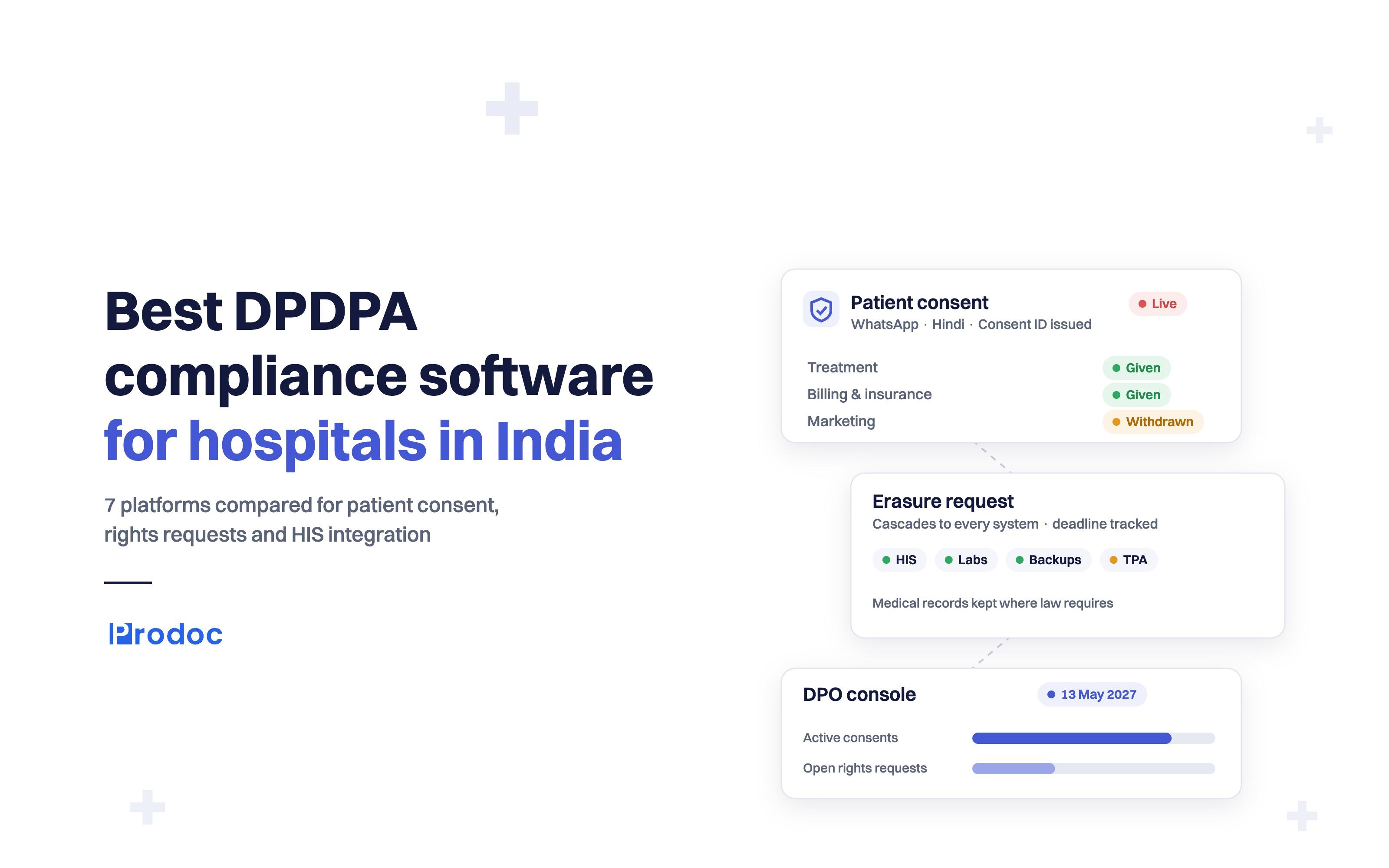
Seven DPDPA compliance platforms compared on what hospitals actually need: patient consent on WhatsApp and voice, rights requests, erasure, breach response and HIS integration.
The best DPDPA compliance software for a hospital is one that captures patient consent where patients actually are (the front desk, WhatsApp, the phone) and connects to the HIS, labs and TPAs that hold patient data. Most DPDPA tools in India were built for banks, fintechs and e-commerce and then extended to healthcare. They are strong on cookie banners, data discovery and enterprise governance, but hospitals have problems those sectors don't: unconscious patients, minors and guardians, medical record retention laws, and data spread across EMR, PACS, labs and insurers.
Most DPDP Act obligations apply from 13 May 2027. This guide compares seven DPDPA compliance platforms against what a hospital actually needs, so you can build a shortlist.
DPDPA compliance software helps an organisation meet its duties under India's Digital Personal Data Protection Act, 2023 and the DPDP Rules, 2025. For a hospital, that means giving patients clear notices, recording purpose-specific consent, handling requests to access, correct or erase data, keeping an audit trail and responding to data breaches. A good platform does this across every place patient data lives, from the registration desk and call centre to the HIS, EMR, labs and insurers.
A hospital's DPDPA tool has to work at the front desk, not just on the website. Check every vendor against these seven needs:
Consent where patients are. Notices and consent over WhatsApp, voice/IVR and in person, in English and the 22 Indian languages listed in the Constitution's Eighth Schedule. Each purpose (treatment, billing, research, marketing) needs its own consent, and withdrawing must be as easy as giving.
Patients who can't consent for themselves. Built-in flows for minors and guardians, persons with disabilities and their lawful guardians, and nominees.
Rights requests across clinical systems. Access, correction and erasure requests that are routed to the teams and systems holding the data, with deadlines tracked.
Erasure that respects retention law. Erasure that cascades to labs, cloud storage and other processors, but stops where medical-records, tax or other laws require you to keep data.
Breach response. A workflow to notify the Data Protection Board and affected patients, with evidence and an audit trail.
Integration with your HIS and EMR. Consent and purposes need to reach the systems that process data. A tool that only stores consent records leaves the actual processing unchecked.
Vendors and processors. Oversight of labs, radiology partners, TPAs, insurers, cloud providers and messaging vendors that handle patient data for you.
Hospitals that process large volumes of sensitive health data may also be notified as Significant Data Fiduciaries, which adds a DPO, periodic data protection impact assessments and independent audits.
Prodoc AI is the only platform here built for hospitals first; the others are general privacy platforms with a healthcare offering or customers. Details come from each vendor's public pages as of November 2026; confirm current features in a demo.
Platform | Built for | Patient consent channels | Healthcare specifics stated | HIS/EMR integration stated | Best for |
|---|---|---|---|---|---|
Hospitals | WhatsApp, voice/IVR, chat; 22 Indian languages | Minor, guardian and PwD flows; erasure cascade to labs, TPAs, backups; DPO console | Yes: FHIR-native, connects to existing EMR/HIS | Hospitals and groups that want consent and rights run inside patient workflows | |
Many industries, healthcare page | Multilingual notices, 22 Indian languages | Vendor risk for labs, TPAs, insurers; SDF advisory; ABHA mentioned | EHRs named as data sources for discovery | Hospitals that want software plus managed privacy services | |
Digital Anumati (AbyM Technology) | Many industries, launched July 2026 | Multilingual consent | ABDM-aligned; maker is an ABDM certified partner | Integrates via APIs; HIS not mentioned | Providers prioritising ABDM-aligned consent records |
Consent forms and e-signatures | Digital, multilingual consent forms | Healthcare consent; healthcare customers outside India named | Public API; no EHR integrations described | Hospitals digitising signed consent forms | |
Enterprises across sectors | Multilingual notices, web and app journeys | Healthcare listed among sectors | Integrates with platforms that collect personal data | Large hospital groups with broad enterprise DPDP programmes | |
Enterprises, BFSI-led | Localised consent, cookie management | None stated | Not stated | Groups already using Digio for e-sign or KYC | |
Global enterprises | Consent across digital channels | None stated for India healthcare | Data-mapping connectors | Multinational groups handling DPDPA alongside GDPR and HIPAA |
Prodoc's DPDPA Compliance Platform is built for hospitals and runs on top of the existing HIS. A patient-facing Consent Agent captures itemised, purpose-specific consent over WhatsApp, voice/IVR and chat in 22 Indian languages, and never touches clinical data. A separate Governance Agent carries out erasures across EMR, lab and backup systems, enforces role-based access and monitors audit logs. The DPO gets one console with a consent registry per patient, rights requests sorted by deadline and an append-only audit log.
Hospital-specific: adult, minor and person-with-disability consent flows; insurance and TPA consent scoped per claim purpose; billing kept separate from marketing.
Erasure: cascades to labs, radiology, cloud storage and backups, with statutory retention overrides for medical records.
Proof: in September 2026 Prodoc signed an MoU with the Association of Healthcare Providers (India) to support member hospitals with DPDPA implementation.
Consider: Prodoc focuses on healthcare. A diversified group that needs one privacy tool for hospitals, pharma retail and other businesses may want a general platform as well.
Best for: hospitals and hospital groups that want consent and patient rights handled inside patient workflows, connected to their HIS.
miniOrange offers a DPDP solution for healthcare and pharma covering purpose-based consent with multilingual notices in 22 Indian languages, rights management with grievance handling, data discovery across EHRs and databases, breach readiness, and vendor risk for labs, insurers, TPAs and CROs. It pairs software with managed services and DPO advisory, including DPIA and RoPA work for Significant Data Fiduciaries.
Consider: the healthcare page names no hospital customers and does not describe HIS integration beyond data discovery.
Best for: hospitals that want software plus a managed privacy team.
AbyM Technology launched Digital Anumati in July 2026 as a consent management platform for many sectors, including hospitals. It offers automated consent collection, audit trails, multilingual support and withdrawal options, is aligned with the ABDM framework, and is cloud-based with API integration. AbyM is an ABDM certified partner.
Consider: a new product; hospital references and HIS integrations are not yet published.
Best for: providers whose priority is ABDM-aligned consent records.
Certinal combines DPDP consent management, healthcare consent and e-signatures in one platform, with multilingual consent forms, real-time audit trails and certifications such as ISO 27001 and SOC. Named healthcare customers include Monash Health in Australia.
Consider: strongest on signed forms; EHR or HIS integrations are not described, and patient-rights and breach workflows are not detailed for hospitals.
Best for: hospitals replacing paper consent forms with digital, signed consent.
Privy is a full-stack DPDP platform covering consent lifecycle management, multilingual notices, rights fulfilment, data discovery and continuous compliance. IDfy reported 50+ enterprise DPDP implementations across BFSI, insurance, telecom, healthcare and retail in October 2026.
Consider: built for enterprise digital journeys (web, app, cookies); check how it captures consent at a hospital front desk or on a voice call.
Best for: large hospital groups running a broad, enterprise-wide DPDP programme.
Digio's CoTrust is a DPDPA consent management platform with modules for data discovery and classification, consent management, data principal rights, RoPA and DPIA.
Consider: Digio's use cases centre on banking, lending, capital markets and insurance; no healthcare-specific features are stated.
Best for: hospital groups already using Digio for e-sign or KYC.
OneTrust is a global privacy platform with a DPDPA solution for consent automation, rights requests (access, correction, erasure, grievance), control frameworks mapped to the DPDPA and breach response.
Consider: a broad global platform that usually needs a partner to implement; India-specific patient channels such as WhatsApp and voice in Indian languages need checking.
Best for: multinational healthcare groups managing DPDPA alongside GDPR or HIPAA.
Ask vendors to show these in a live demo using a hospital scenario, not slides.
Show consent being captured from a patient on WhatsApp and on a voice call in Hindi or a regional language. What does the patient receive as proof?
How are treatment, billing, research and marketing consents kept separate, and how does a patient withdraw one of them?
How do you handle consent for a minor, an unconscious emergency patient and a person with a disability?
Which HIS, EMR and lab systems do you already integrate with, and how does a withdrawal stop processing in those systems?
When a patient asks for erasure, which systems does it reach (labs, PACS, backups, TPAs), and how do you stop where medical-records law requires retention?
How are access and correction requests routed, tracked and closed within the required timelines?
Walk through a breach: who is alerted, what is sent to the Data Protection Board and patients, and what evidence is kept?
Where is patient data hosted, and are audit logs append-only and exportable?
Which hospitals in India use the platform today, and can we speak to one?
What does go-live take for a hospital of our size, and what does our team need to do?
It depends on your scope. Hospital-native platforms such as Prodoc AI suit hospitals that need consent and patient rights handled across WhatsApp, voice and the HIS. General platforms such as Privy by IDfy or OneTrust suit groups managing DPDPA across many businesses or alongside GDPR and HIPAA.
Most obligations apply from 13 May 2027, 18 months after the DPDP Rules, 2025 were notified in November 2025. These include notice and consent, patient rights, security safeguards and breach reporting.
Yes. Every hospital, clinic and diagnostic centre that processes patient data in digital form, including paper records that are later digitised, is a data fiduciary under the Act.
A consent management platform is software a hospital uses to collect and manage consent. A Consent Manager is a separate entity registered with the Data Protection Board that patients can use to manage consents across organisations. Hospitals need a consent management platform; using a registered Consent Manager is optional.
No. ABDM governs how health records are linked and shared through ABHA. DPDPA covers all personal data a hospital processes, including billing, call-centre and marketing data, and adds obligations such as breach reporting and patient rights.
The Data Protection Board can impose penalties of up to ₹250 crore for failing to take reasonable security safeguards, and up to ₹200 crore each for failing to notify a breach or breaching rules on children's data. See why hospital leaders must act before May 2027.
DPDPA compliance in a hospital is less about buying a tool and more about changing how patient data is handled every day: at registration, on the phone, in the lab and at discharge. Whichever platform you choose, start with a map of where patient data flows, test consent and rights requests with real hospital scenarios, and leave time before 13 May 2027 to train staff and fix gaps. The right software makes that work repeatable and provable; it cannot replace a clear plan and an accountable team.
See it in action: book a 30-minute demo of the DPO console and get a scoped DPDPA rollout plan for your hospital. Book a personalised demo
Disclosure: this guide is published by Prodoc AI, one of the vendors compared. Competitor details come from each vendor's public website and press coverage as of November 2026; features change, so confirm them in a demo. This article is not legal advice.
Talk to our team about patient acquisition, OPD, IPD, and retention workflows for your hospital.