Back to Blogs & Insights

From Paper Prescriptions to ABHA-Ready Records: Why Ambient Scribing Is the Missing Link

Bishnu NathDigital Marketing Manager, Prodoc AI25 November 20267 min read
ABHAE-PrescriptionAmbient ScribingABDMClinical DocumentationOPD Intelligence
From Paper Prescriptions to ABHA-Ready Records: Why Ambient Scribing Is the Missing Link

Health Minister J.P. Nadda wants doctors on e-prescriptions and ABHA records. Ambient AI scribing makes it practical in busy Indian OPDs.

The Health Minister’s Message to India’s Next Doctors

On 21 November 2026, Union Health Minister J.P. Nadda gave India's newest doctors a clear task: stop writing prescriptions on paper. At JIPMER's 15th convocation in Puducherry, he urged them to move to electronic prescriptions and help digitise patient records under the Ayushman Bharat Health Account (ABHA) system. He said this would make care more efficient and easier to access (News On AIR).

He also said the Ayushman Bharat Digital Mission (ABDM) is bringing a “major transformation” to the health sector. Other figures from the speech show the scale of what lies ahead:

  • More than 13 crore people have received hospital treatment under Ayushman Bharat, and over Rs 2 lakh crore has been paid to hospitals.

  • Everyone aged 70 and above now gets up to Rs 5 lakh of cover a year, whatever their income.

  • Postgraduate medical seats have grown from 31,000 to 91,500, and the target is 75,000 more undergraduate seats by 2029.

The direction is clear. The harder question for hospitals is how to get there without adding to doctors' workload.

The National System Is Ready. Clinics Are the Gap

India has built one of the largest digital health networks in the world. As of 10 July 2026, ABDM had created more than 93.95 crore ABHA numbers and linked over 105 crore digital health records (GKToday). Linked records went from 50 crore in February 2025 to 100 crore in about 15 months, and more than 450 health tech solutions now connect to the network (NewKerala).

The accounts exist. What the network still needs is a steady flow of good clinical data from every consultation. Nadda said as much in July, when he told the ABDM Mission Steering Group that the next phase must focus on adoption and use across the country (The Pioneer).

That data starts in the OPD, with the prescription and the clinical note. If those stay on paper, the patient's ABHA record stays thin, however many accounts are created.

Why Doctors Still Reach for the Paper Pad

Most doctors aren't against digital records. The problem is time. In a busy Indian OPD, a doctor may see dozens of patients in one session, often a few minutes each. Typing a structured note and a prescription into an EMR during that time means looking at a screen instead of the patient. It also means queues get longer.

That is why so many e-prescription rollouts stall. When the digital step is extra work on top of the consultation, doctors fall back to paper, or a staff member types it up later. Either way, data goes missing or gets copied in wrong.

The usual friction points:

  • Typing slows the consultation. Every minute at the keyboard is a minute not spent with the patient, and the OPD queue feels it.

  • Free text doesn't help ABHA. A paragraph of notes is hard to share or reuse. Records are only useful when complaints, diagnoses and medicines are captured in a structured way.

  • Many languages in one room. Consultations move between English, Hindi and regional languages, often in the same sentence.

  • Doctors switch between systems. Different hospitals run different HIS and EMR platforms, and a tool that works with only one of them doesn't spread.

With tens of thousands of new doctors joining every year, the habits they form now will last decades. Asking them to type more won't work. The fix has to take work away.

How Ambient Scribing Turns the Minister’s Ask Into a Daily Habit

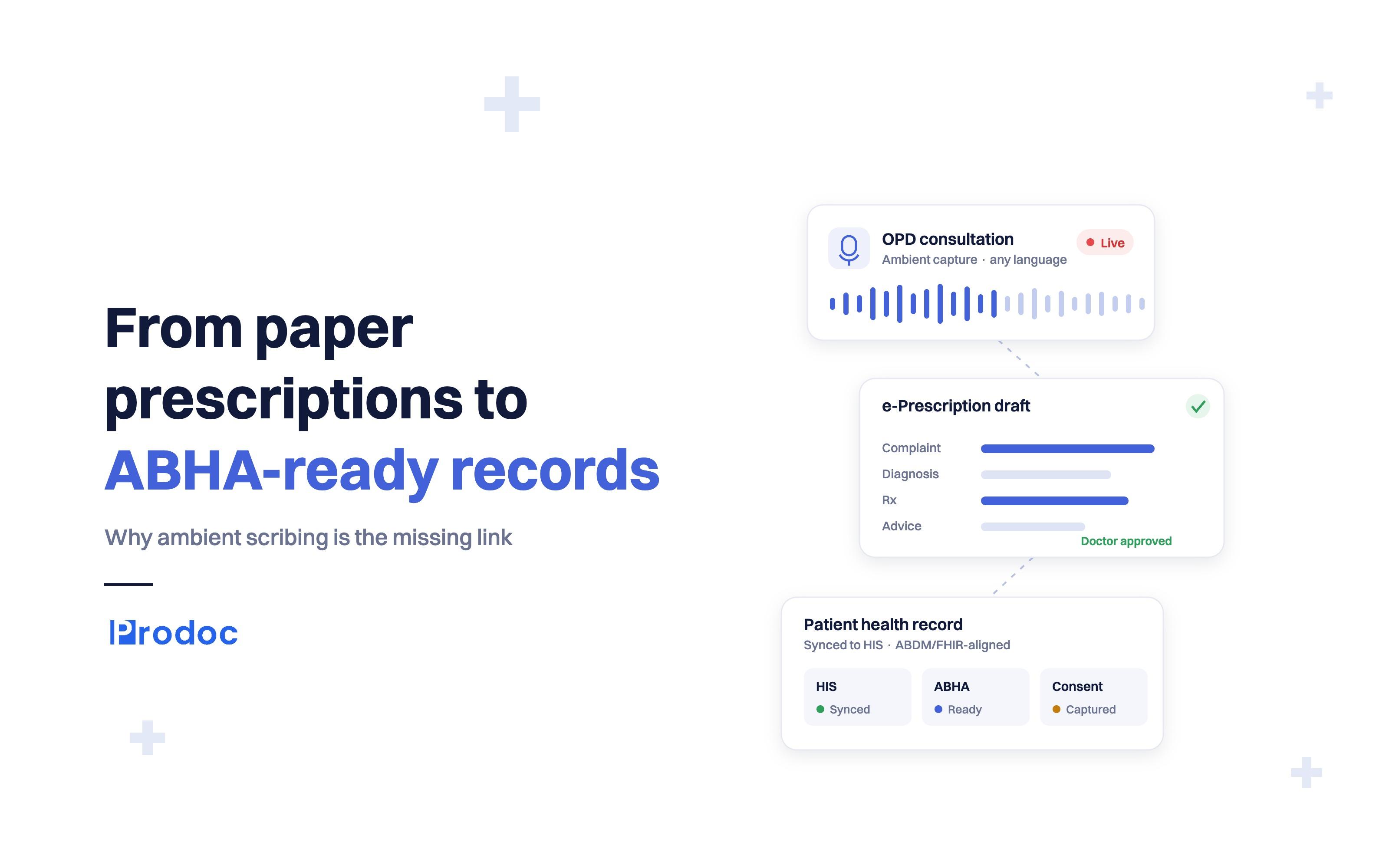
Ambient scribing flips the order of work: the doctor talks to the patient as usual, AI listens in the background, and then drafts the clinical note and e-prescription for the doctor to check. The digital record becomes a by-product of the consultation, not an extra job after it.

Prodoc Ambient Scribing, part of our OPD Intelligence suite, works like this:

  1. Consultation. The doctor speaks with the patient. No typing, in the languages they already use.

  2. Ambient capture. The conversation is transcribed live or from a recording.

  3. Structured draft. AI organises it into chief complaint, diagnosis and prescription, and drafts the e-prescription.

  4. Doctor approval. The doctor reviews and edits the draft. The AI does not diagnose.

  5. Synced to the HIS. The approved note and e-prescription go to the hospital's existing HIS.

  6. Interoperable record. The structured, ABDM- and FHIR-aligned record is ready to share with patient consent.

Each step answers one of the friction points above:

  • No typing during the consultation. The doctor can stay focused on the patient.

  • Structured notes, not free text. That structure is what makes a record useful once it is shared.

  • E-prescriptions drafted for you. The prescription is built from the consultation and approved together with the note. This is the paper-to-digital switch the minister asked for, with almost no extra effort.

  • Built for Indian consultations. It is multilingual and works with whichever HIS the hospital already runs.

  • The doctor stays in charge. The AI records what the doctor says, and every note and prescription is approved by the doctor before it reaches the HIS.

  • Interoperable and compliant. It is designed around FHIR-based interoperability with DPDP compliance built in.

The result: less time on documentation, faster consultations, and a complete digital record from every visit.

What This Means for Hospital Leaders

The government has set the direction. Hospitals that make digital prescribing easy for doctors will move fastest. Those that rely on extra typing will see adoption stall in the OPD.

Three reasons to act now:

  1. Doctors' habits form early. Over 91,500 postgraduate seats and a growing intake of graduates mean a large wave of new doctors. Give them a workflow that saves time from day one.

  2. Records are becoming a must-have. With ABHA records spreading, patients and payers will expect consultation data to move with the patient. That includes Ayushman Bharat cover for everyone over 70.

  3. Better records improve everything after the OPD. Structured notes make follow-ups, referrals and billing faster and more accurate.

A quick readiness check for your OPD

  • What share of OPD prescriptions are electronic today?

  • How many minutes per consultation do doctors spend typing?

  • Is your HIS ABDM-enabled, and are consultation records being shared to ABHA?

  • Are notes structured (complaint, diagnosis, medicines) or free text?

  • Does every AI-drafted note need a doctor's approval before it is saved?

  • Is patient consent captured in line with the DPDP Act?

If more than two of these are unclear, ambient scribing is a good place to start. It gets doctors on board without asking for extra effort.

Frequently Asked Questions

What did J.P. Nadda say about electronic prescriptions?

At JIPMER's 15th convocation on 21 November 2026, he urged young doctors to move from paper to electronic prescriptions. He also asked them to help digitise patient records under the ABHA system, to make care more efficient and accessible.

What is ABHA?

The Ayushman Bharat Health Account is a 14-digit health ID created under ABDM. It links a person's health records across providers, with their consent.

What is ambient clinical documentation?

It is AI that listens to a doctor-patient conversation and drafts a structured clinical note and prescription. The doctor reviews and approves the draft. No typing is needed during the consultation.

Does an AI scribe make diagnoses?

No. Prodoc Ambient Scribing records the diagnosis the doctor states. Every note and prescription needs the doctor's approval before it reaches the HIS.

Does it work with our existing HIS or EMR?

Yes. Prodoc Ambient Scribing works with any HIS and is designed to be ABDM- and FHIR-aligned.

Does it support Indian languages?

Yes. It works across the languages doctors and patients use in consultations, including mixed-language conversations.
Make Every Consultation ABHA-Ready

The minister has asked India's doctors to go digital. The quickest way is to let them keep talking to their patients and have the paperwork done for them. Prodoc Ambient Scribing captures the consultation, drafts the note and e-prescription, and keeps the doctor in charge of what goes on record.

Related Reading

Sources

Want to see Prodoc in action?

Talk to our team about patient acquisition, OPD, IPD, and retention workflows for your hospital.