Automated discharge summaries
Summaries build from the patient's record as the stay progresses, so they're ready near-instantly once a doctor confirms discharge.
New: India's DPDP Act requires all healthcare providers to be compliant by May 2027. See how Prodoc helps.
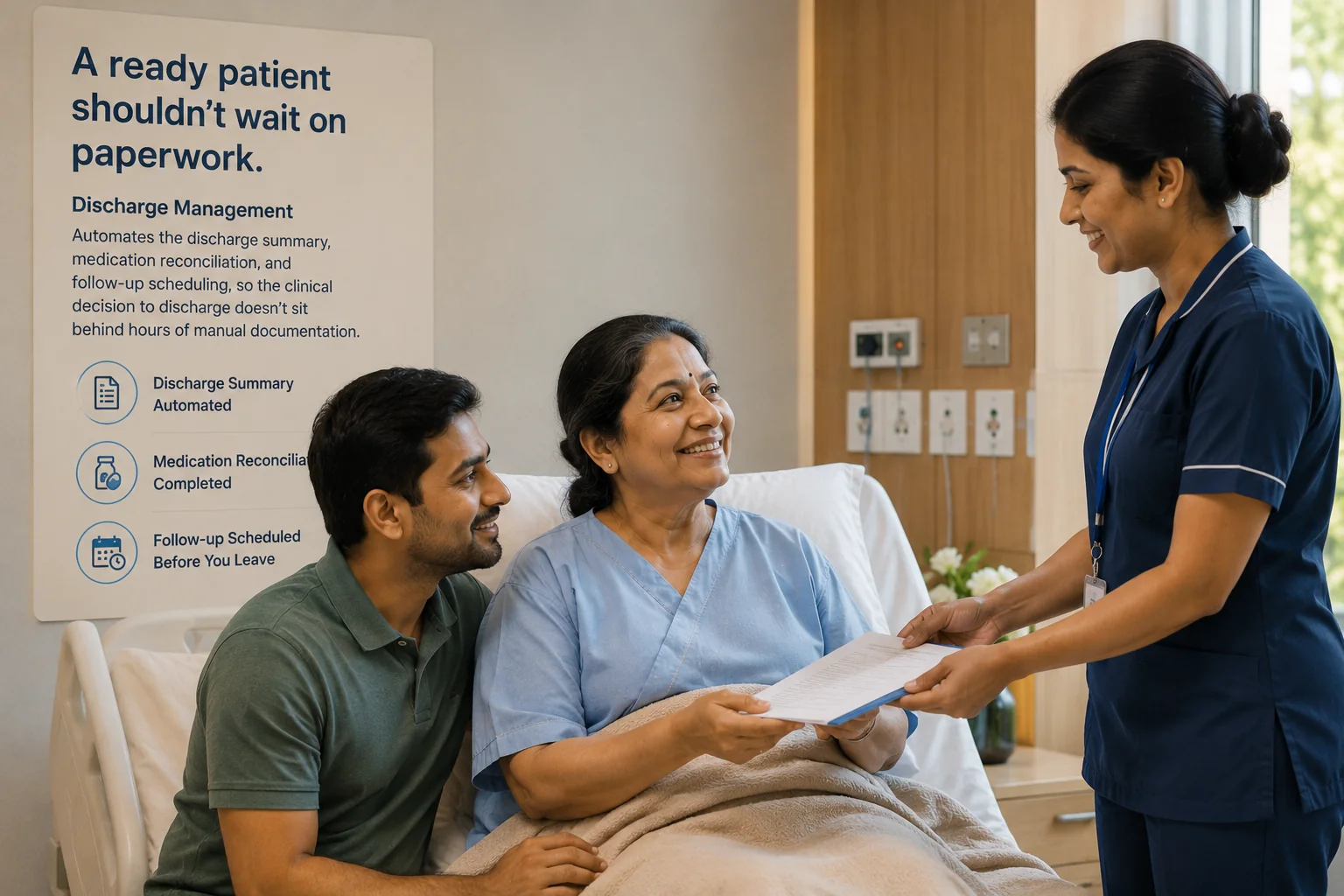
Discharge Management
Automate discharge documentation, medication instructions, and follow-ups in one connected workflow.
20%
reduction in time to discharge
25%
fewer 30-day readmissions
4 hrs
average bed-turnaround saved
Discharge summaries are often drafted after the doctor has already decided the patient can leave, adding hours before the patient can actually go.
Cross-checking what a patient was on against what they're leaving with is rushed at the point of discharge, when there's least time to get it right.
The next appointment or investigation is often left for the patient to organise themselves, once they've already left.
Every hour a discharged patient occupies a bed is an hour that bed isn't available for the next admission.
Ananya Desai · Ward B · Bed 214
Expected discharge · 15 Sept · Cardiology team
Pulled from admission note · reviewed
Knee arthroscopy · Dr. Iyer
Day 3 vitals + nursing notes pending
4 meds reconciled against admission list
Summaries build from the patient's record as the stay progresses, so they're ready near-instantly once a doctor confirms discharge.
Cross-check pre-admission, in-stay, and discharge medications systematically, reducing the chance of an error at the handoff point.
Book the next appointment or investigation as part of discharge, so the patient leaves with a plan, not a task.
See which patients are discharge-ready and where paperwork is the bottleneck, so beds turn over faster.
Discharge
20%
reduction in time to discharge
Readmissions
25%
fewer 30-day readmissions
Medication
40%
fewer discharge-related medication errors
Beds
4 hrs
average bed-turnaround time saved
01
Less time between the clinical decision and the patient actually leaving, because the paperwork isn't starting from zero.
02
Reconciliation happens systematically, not under time pressure.
03
Follow-ups are booked before the patient leaves, rather than left to chance.
No. It runs alongside your existing HIS, drawing on the patient's record where APIs support it.
Book a demo and we'll show you how it runs on your discharge volume and your existing systems.