Back to Blogs & Insights
Prodoc CRM vs Zoho CRM: How Do They Compare?
Bishnu NathDigital Marketing Manager, Prodoc AI29 September 20268 min read
Healthcare CRMZoho CRM AlternativePatient EngagementHospital CRMPatient Acquisition
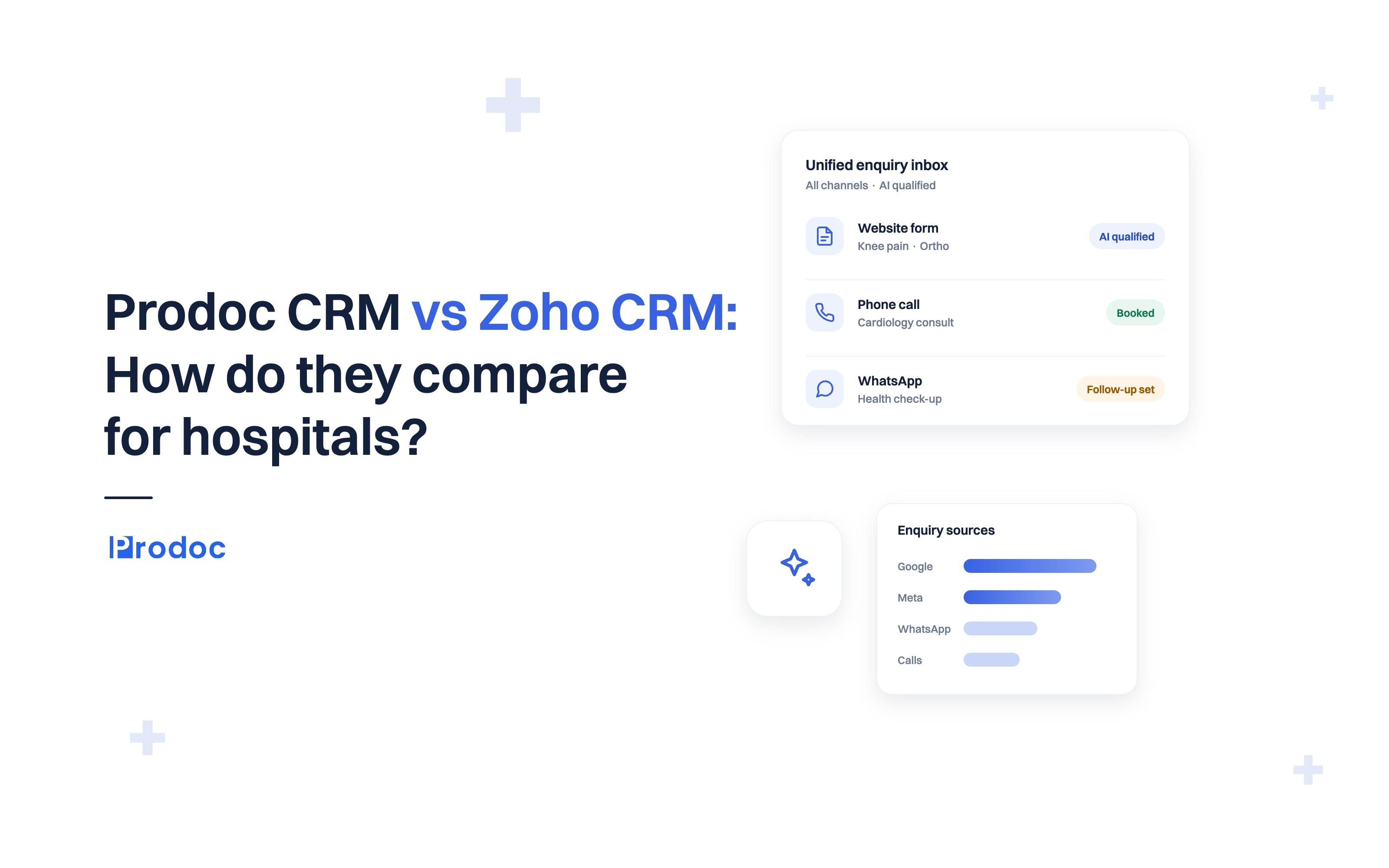
Compare Prodoc CRM vs Zoho CRM. Explore key differences, features, benefits and limitations to find the right AI-powered healthcare CRM for hospitals.
A patient enquiry shouldn't become another pending task on your hospital's dashboard.
Imagine a patient calling a hospital to book an appointment. The call goes unanswered. The patient sends a message, waits for a reply and eventually contacts another hospital. The enquiry was generated. The opportunity was lost.
This is one of the problems healthcare CRM software aims to solve. Both Prodoc CRM and Zoho CRM help healthcare organisations manage patient relationships, automate communication and improve efficiency, but they approach patient engagement differently.
Zoho for Healthcare offers a broad CRM ecosystem with patient management, appointment scheduling, communication tools and workflow automation. Prodoc AI Patient Engagement CRM focuses on turning patient enquiries into conversations and appointments through conversational AI.
So which platform is better for hospitals? Let's compare their features, benefits, differences and limitations.
Feature | Zoho for Healthcare | Prodoc CRM |
|---|---|---|
Built for | Healthcare organisations, on Zoho's multi-industry business suite | Hospitals and healthcare providers only |
Core approach | Configurable CRM environment | AI-first patient acquisition and engagement |
AI conversations | Chatbots and AI tools; capability depends on the apps and setup chosen | Voice and chat AI agents that understand intent and support booking |
Lead management | Multi-source capture, assignment and tracking | Calls, website, WhatsApp and ads, with AI qualification by intent, specialty and priority |
Appointments | Scheduling, calendar integration and notifications | Booking inside the patient conversation through supported integrations |
Follow-ups | Reminders, segmentation and marketing campaigns | Multi-step Care Journeys and conversational re-engagement |
Referrals | Referral tracking | Separate Partner & Referral Management module |
HIS / EHR | EHR/HIMS and third-party integrations | Works with your existing HIS and call-centre setup |
Best fit | Organisations wanting broad customisation | Hospitals prioritising AI-led enquiry-to-appointment conversion |
Zoho details are based on Zoho's public website as of November 2026. Confirm current features with the vendor.
Prodoc CRM is an AI-powered patient engagement platform designed specifically for hospitals. It helps hospitals capture enquiries, understand patient intent, automate routine communication and support appointment booking through voice and chat.
Unlike a conventional CRM that mainly records enquiries for staff to process, Prodoc brings AI conversations directly into patient acquisition. Its core strength is connecting the enquiry, the AI interaction, the CRM record and the appointment workflow.
Zoho for Healthcare is a configurable CRM built on the wider Zoho ecosystem. It offers tools for patient management, appointment scheduling, omnichannel communication and administrative automation. Hospitals can configure workflows, manage patient information, automate reminders and integrate supported healthcare systems.
Zoho is particularly useful for organisations that want extensive customisation and access to a broader suite of business applications.
The key difference: Zoho provides a configurable healthcare CRM environment, while Prodoc offers a specialised, AI-first approach to hospital patient acquisition.
Zoho CRM: Supports omnichannel communication, chatbots, telephony and configurable automation. AI functionality depends on the products and configuration selected.
Prodoc CRM: AI agents respond to routine enquiries through voice and chat, understand the request and support the next step. A patient who contacts the hospital after hours gets an answer without waiting for reception.
Why Prodoc stands out: its conversational AI is closely connected to hospital enquiry handling and appointment workflows.
Zoho CRM: Captures, assigns, organises and tracks patient enquiries from different sources.
Prodoc CRM: Captures enquiries from calls, websites, WhatsApp, digital ads and other channels. AI identifies intent, specialty and priority while keeping one conversation history per patient.
Why Prodoc stands out: it combines lead management with AI qualification, so teams can prioritise the enquiries that matter.
Zoho CRM: Supports appointment scheduling, calendar integration and automated notifications.
Prodoc CRM: Connects patient conversations with appointment availability and booking through supported integrations. Patients can ask about a consultation, get answers and move towards booking in the same conversation.
Why Prodoc stands out: booking becomes part of the patient interaction, not a separate admin task.
Zoho CRM: Supports automated reminders, patient segmentation and marketing communication.
Prodoc CRM: Supports multi-step Care Journeys, post-consultation communication, reminders and conversational re-engagement campaigns.
Why Prodoc stands out: patients can reply to outreach and keep the conversation going with AI. See how this works in patient retention.
Zoho CRM: Supports EHR/HIMS integrations and connections with third-party applications.
Prodoc CRM: Works with your existing HIS and call-centre setup, connecting patient communication with supported appointment workflows.
Why Prodoc stands out: its integrations are designed around the hospital's existing acquisition and scheduling processes.
Prodoc CRM helps hospitals respond to, engage and act on patient enquiries in one connected workflow.
24/7 conversational AI: AI agents answer routine enquiries by voice and chat at any time. Benefit: patients are engaged even when staff are busy or away.
Intelligent enquiry qualification: AI identifies intent, sentiment, priority and specialty. Benefit: teams focus on enquiries that need human attention.
Booking within conversations: conversations connect to real-time availability through supported scheduling integrations. Benefit: fewer manual steps from enquiry to appointment.
Unified patient communication: conversations across channels sit in one shared record. Benefit: patients aren't asked for the same information twice.
Human handoffs and call-centre support: when AI can't resolve an enquiry, it hands over to staff. Benefit: people stay responsible for complex and sensitive conversations.
Patient engagement analytics: reports on enquiry sources, conversations, bookings, campaigns and call performance. Benefit: hospitals see where enquiries convert or drop off.
For hospitals looking beyond CRM, Prodoc also offers the Patient Journey OS, including OPD Intelligence.
Centralised patient records: patient information, interaction history and communication details in one place.
Appointment management: scheduling, calendar integrations and automated reminders.
Omnichannel communication: email, SMS, WhatsApp and telephony across the Zoho ecosystem.
Marketing automation: campaign management, segmentation and automated outreach.
Customisation and integrations: configurable workflows and connections with other applications.
Where Prodoc differs: Prodoc focuses on connecting AI-led patient conversations with enquiry qualification and appointment actions.
Every healthcare CRM has trade-offs. Knowing them helps hospitals decide.
Hospital-specific workflows may need configuration. Specialised workflows can require extra setup depending on the hospital's needs.
Conversational booking needs evaluation. Zoho offers chatbots and AI tools, but hospitals should confirm how their configuration supports AI voice conversations, enquiry qualification and booking.
Multiple applications may be involved. CRM, marketing, scheduling and other workflows may need separate Zoho apps connected together.
More flexibility means more implementation decisions. Hospitals must define their processes, integrations and automation rules.
Designed specifically for healthcare. Organisations wanting one general-purpose CRM across unrelated industries may prefer a broader platform.
Integration compatibility must be checked. Specific HIS and telephony integrations depend on the hospital's existing systems.
Some hospital capabilities are separate products. OPD Intelligence and Partner & Referral Management are separate modules within the Patient Journey OS.
You want extensive customisation across a broad business software ecosystem.
You already use other Zoho apps and want one vendor across departments.
Your team can configure and maintain workflows, integrations and automation rules.
You want AI agents that answer and qualify enquiries by voice and chat, 24/7.
You want patients to move from enquiry to booked appointment in one conversation.
You want a hospital-only CRM that works with your existing HIS and connects to referrals, OPD and follow-up care.
A hospital CRM should show what happened to every patient enquiry, not just how many enquiries came in.
Consider a hospital running campaigns on Google and Meta. One patient submits a website form, another calls, and a third sends a WhatsApp message. With Prodoc CRM, all three enter one engagement workflow. AI identifies what each patient needs, starts the conversation, supports booking and keeps follow-ups going. Teams then review enquiry sources, bookings and engagement performance in dedicated reports.
This is especially useful for hospital marketing heads, call-centre managers and administrators who need visibility into patient acquisition. Hospitals such as Madhavbaug use Prodoc to strengthen patient acquisition.
For referral relationships, Prodoc also offers a separate Partner & Referral Management solution. To see which capabilities matter most when evaluating platforms, read our guide to healthcare CRM software for hospitals in India.
Zoho for Healthcare is a configurable CRM built on Zoho's wider business suite. Prodoc CRM is an AI-first CRM built only for hospitals, with AI agents that answer, qualify and help book patient enquiries in the same conversation.
Yes, for hospitals that prioritise AI-led patient conversations, enquiry qualification and conversational booking. Zoho may suit organisations that want broad customisation across many business apps.
Yes. Zoho supports chatbots and AI tools across its ecosystem. Hospitals should check how their chosen setup handles AI voice conversations, qualification and booking.
Yes. Prodoc works alongside your existing HIS and call-centre setup. Specific integrations depend on your systems, so confirm them during evaluation.
Referrals are handled by Prodoc's Partner & Referral Management module, which is a separate solution within the Patient Journey OS.
The right healthcare CRM shouldn't just organise patient information. It should help hospitals act on it.
Zoho CRM offers useful capabilities for patient management, scheduling, communication, marketing automation and reporting, and its configurable ecosystem suits organisations with broad administrative needs.
Prodoc CRM is a compelling choice for hospitals that want AI-powered patient engagement, intelligent enquiry qualification, conversational booking and hospital-focused analytics, while keeping hospital teams in control.
Disclosure: This comparison is published by Prodoc AI. Zoho information is based on its public website as of November 2026.
Talk to our team about patient acquisition, OPD, IPD, and retention workflows for your hospital.