Back to Blogs & Insights
Why Prodoc AI Is the Best AI Medical Scribe for Hospitals in India
Bishnu NathDigital Marketing Manager, Prodoc AI10 September 20267 min read
AI Medical ScribeAmbient ScribingClinical DocumentationOPD IntelligenceHospital AI
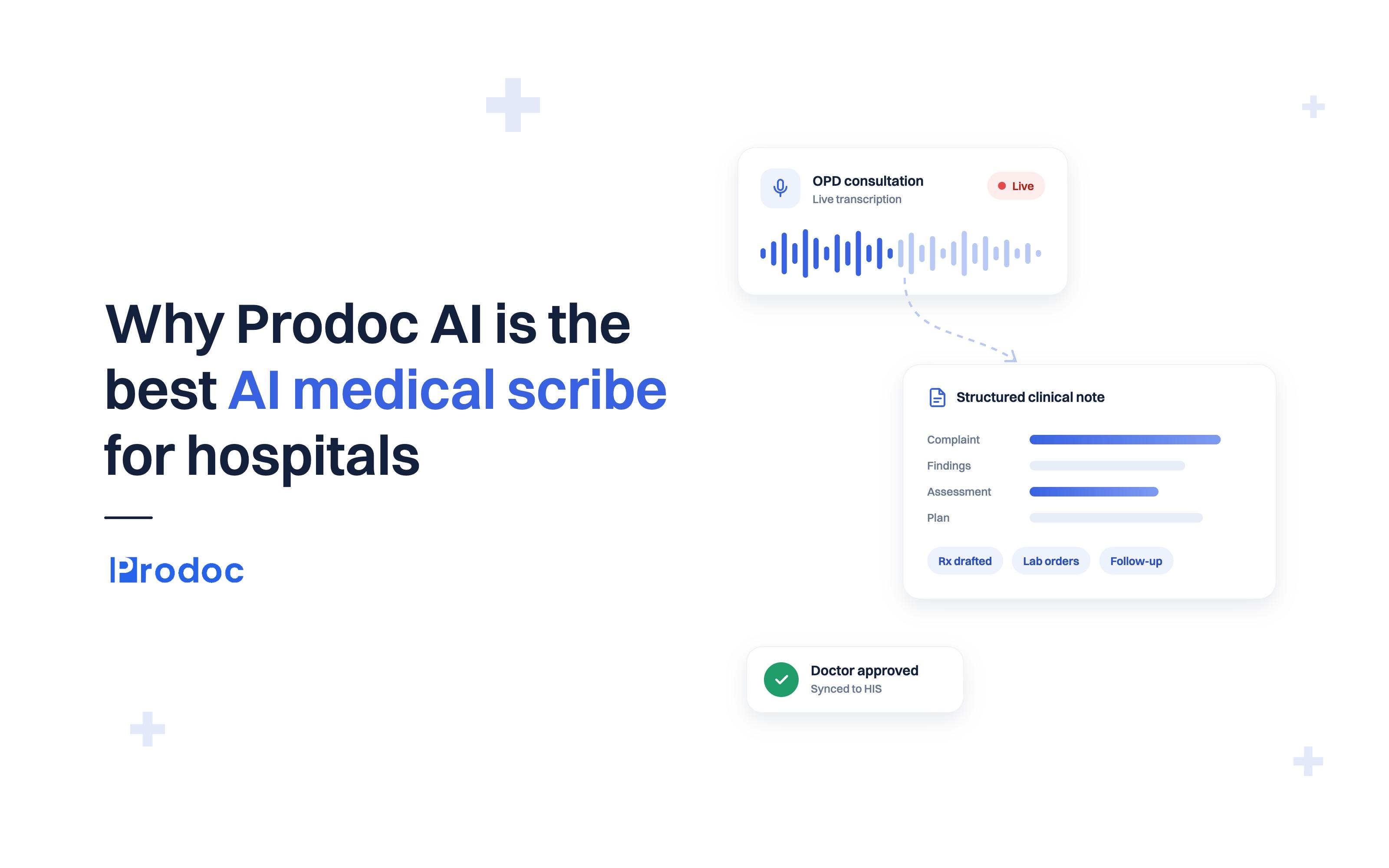
Discover how Prodoc AI ambient scribing helps hospitals automate clinical notes, simplify documentation and connect consultations with OPD workflows.
A doctor's most valuable time should be spent understanding patients, not typing clinical notes.
Every consultation involves listening to patients, understanding symptoms, documenting findings, preparing prescriptions and recommending the next steps. Yet manual documentation often takes attention away from the patient sitting in front of the doctor.
This is where AI medical scribing software for hospitals is changing the way clinical documentation works.
With Prodoc AI Ambient Scribing, hospitals can turn natural doctor-patient conversations into structured clinical notes, prescriptions and orders while keeping doctors in control.
But Prodoc AI goes beyond simplifying documentation. It connects clinical information with the wider hospital journey, helping improve coordination across OPD departments.
AI medical scribing, also called ambient AI scribing, is software that listens to a doctor-patient consultation, with the patient's consent, and converts it into structured clinical documentation that the doctor reviews and approves.
Unlike traditional dictation tools, ambient AI scribes work in the background while doctors continue their natural conversations with patients. The doctor does not have to stop, type or dictate a separate note after the visit.
Prodoc AI acts as an AI-powered clinical documentation assistant, helping doctors focus on consultations while preparing structured notes for their review. For the wider context on how voice technology is reshaping the consultation room, read our guide to voice AI and ambient documentation.
Dictation software: The doctor speaks the note, usually after the consultation. It still uses the doctor's time, and the output is mostly free text.
Medical transcription: A recording is converted to text by people or software, often with a delay. The output is a transcript, not a structured clinical record.
Ambient AI scribe: Runs in the background during the consultation and produces a structured note, draft prescription and diagnostic orders, ready for the doctor to approve.
Busy hospitals face three common documentation challenges:
Time spent typing clinical notes during or after every consultation.
Incomplete documentation when notes are written from memory between patients.
Difficulty sharing clinical information across departments when notes are handwritten or in shorthand.
Indian hospitals add a few more: very high OPD volumes, consultations that switch between languages, and the need to capture and record patient consent in line with the DPDP Act. An AI scribe built for India has to handle all of these. Read more on DPDPA compliance for hospitals.
Prodoc AI simplifies clinical documentation in four connected steps:
Capture the consultation: Prodoc captures doctor-patient conversations through live transcription or processes a recorded consultation, with appropriate patient consent.
Generate structured clinical notes: AI organises the conversation into a draft clinical summary, including complaints, findings, assessment and treatment plan.
Prepare prescriptions and orders: Prodoc extracts the prescription details and diagnostic orders discussed by the doctor and prepares them for review.
Doctor review and approval: The doctor reviews, edits and approves the documentation before it is finalised and shared with the hospital's systems.
The result is a more streamlined documentation workflow, without removing clinical decision-making from doctors.
Doctors should be able to maintain eye contact, listen carefully and focus on patient concerns without constantly switching between the patient and a computer screen.
Prodoc AI Ambient Scribing reduces manual note-taking by preparing clinical documentation from the consultation itself. Doctors spend less time on repetitive documentation and keep a more natural consultation experience.
For hospitals managing high OPD volumes, less administrative effort also supports smoother OPD workflows.
Clinical documentation is more useful when information is organised and accessible. Handwritten notes, shorthand and delayed documentation make it difficult for other departments to understand what happened during a consultation.
Prodoc AI converts doctor-patient conversations into structured clinical summaries, capturing complaints, findings, assessment and care plans in a consistent format. The doctor reviews and approves the information before it is finalised.
This supports clearer communication and keeps clinical context intact as patients move through the patient journey.
A consultation often includes more than a diagnosis. Doctors may advise blood tests, imaging, medication or follow-up visits. When this is documented manually, important details can be missed or need extra coordination.
Prodoc AI drafts prescriptions and diagnostic orders from the consultation and presents them for the doctor to review, correct and approve. The AI does not independently prescribe medication or make clinical decisions.
By capturing the doctor's instructions in a structured format, Prodoc supports more organised documentation and smoother coordination of the patient's next steps.
What happens after the consultation is just as important as what happens inside it. A patient may need to visit the laboratory, collect medicines or return for a follow-up appointment. When documentation and hospital operations run separately, patients and staff face avoidable coordination problems.
Through its OPD Intelligence Platform, Prodoc connects ambient clinical documentation with patient flow and queue management, department workflows and real-time operational visibility. Hospitals can coordinate journeys that include check-in, consultation, diagnostics and pharmacy, and follow-up.
Instead of treating the clinical note as the end of the process, Prodoc carries the doctor's approved instructions into the wider OPD journey. Ambient scribing becomes part of a connected hospital workflow, not an isolated documentation tool.
Hospitals already rely on Hospital Information Systems (HIS) and Electronic Medical Records (EMR) to manage patient information. Introducing AI medical scribing should not mean replacing them.
Prodoc AI works with your existing HIS, so hospitals can add AI-powered clinical documentation alongside established workflows. Its FHIR-based integration architecture supports structured documentation and hospital coordination, while doctors retain control over clinical records.
For multispeciality hospitals, this matters most when different departments need access to the same patient information.
The best AI medical scribing software does more than convert speech into text. Use this checklist when evaluating options:
Ambient capture: works in the background, live or from a recording.
Structured output: complaints, findings, assessment and plan, not a block of free text.
Prescription and order drafting that the doctor approves.
Doctor approval before anything reaches the HIS.
HIS/EMR integration without replacing your current system.
Multilingual support for real Indian consultations.
Consent and data protection aligned with the DPDP Act, with secure handling of recordings and transcripts.
Workflow connection: the note should trigger the next steps in the OPD, not stop at documentation.
Prodoc AI brings all of these together: ambient transcription, structured clinical notes, prescription drafting, doctor approval and OPD workflow coordination.
For hospital administrators: less documentation workload and better operational coordination.
For doctors: more attention on patients, with full control over clinical documentation.
For patients: a more connected experience as they move from consultation to the next stage of care.
The best AI medical scribe for an Indian hospital captures the consultation in the background, produces structured notes, drafts prescriptions and orders for doctor approval, works with the existing HIS, supports multiple languages and handles consent under the DPDP Act. Prodoc AI Ambient Scribing is built for these needs and also connects the approved note to OPD workflows.
No. Prodoc AI documents what happens in the consultation, including the diagnosis the doctor states. Prescriptions and orders are drafts until the doctor reviews and approves them.
Yes. Prodoc is HIS-agnostic and sends the doctor-approved note to your existing system. See our integrations for details.
Prodoc is built for the languages doctors and patients actually use in Indian consultations, including conversations that mix languages. Ask for the current language list during a demo.
Yes. Consultations are captured with appropriate patient consent, and recordings and transcripts are handled securely in line with the DPDP Act.
Medical transcription turns a recording into text, often after a delay. An ambient AI scribe works during the consultation and produces a structured clinical note, draft prescription and orders ready for the doctor's approval.
Pricing depends on consultation volume and the modules a hospital uses. See Prodoc pricing or book a demo for a quote based on your OPD.
The real power of AI medical scribing is not just documenting what doctors say. It is helping hospitals act on what doctors decide.
As hospitals adopt AI-powered clinical documentation, the focus is shifting from simply reducing typing to creating connected clinical workflows. With Prodoc AI Ambient Scribing, hospitals can simplify clinical documentation, support doctors and connect consultations with their wider OPD operations.
Because better documentation should lead to better coordination, not just faster note-taking.
Talk to our team about patient acquisition, OPD, IPD, and retention workflows for your hospital.